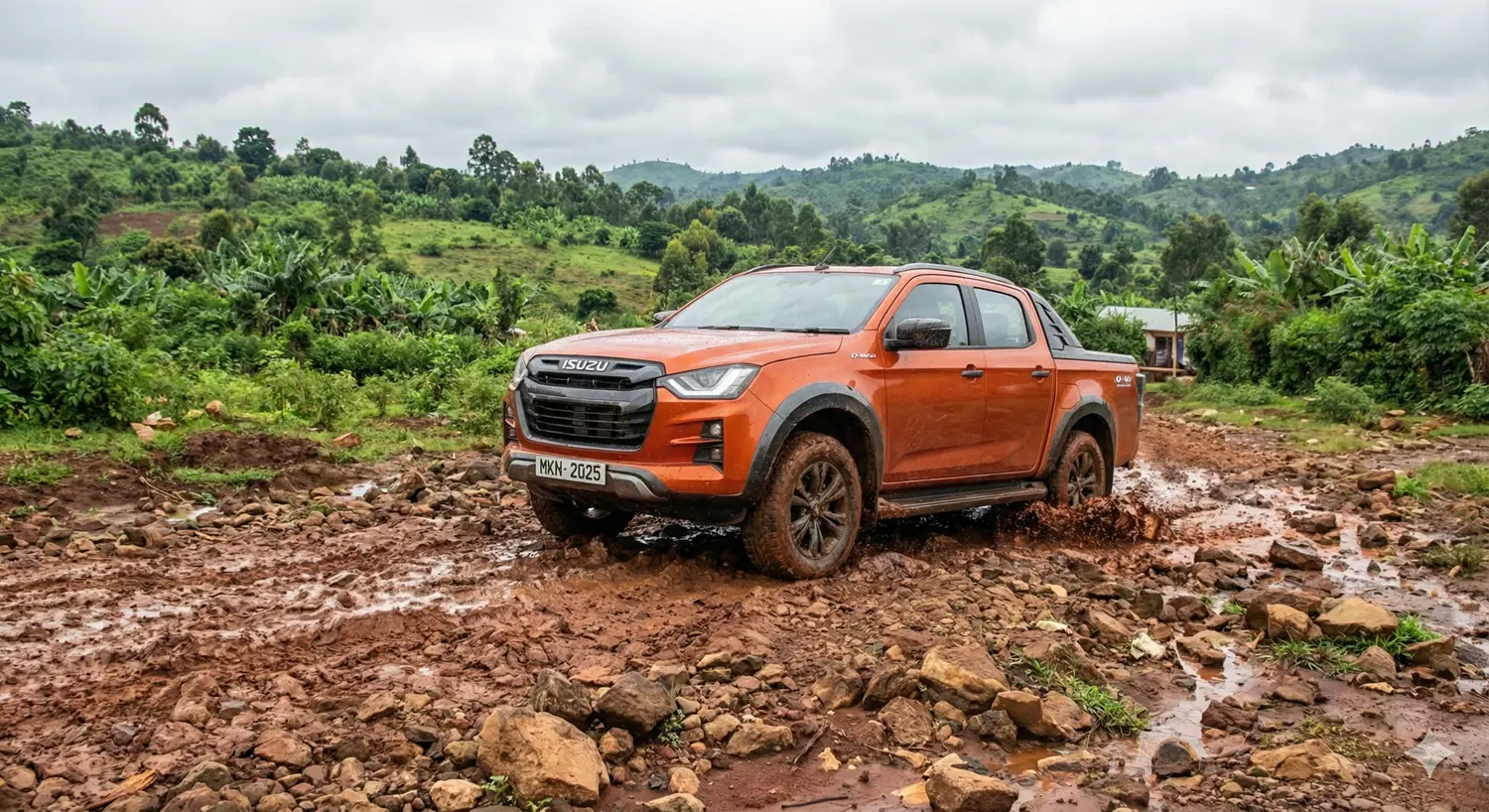
Both the Isuzu mu-X and D-Max are built on the same tough ladder-frame chassis, powered by the same family of 4JJ1 turbodiesel engines, and serviced through the same well-supplied parts network across Kenya. On paper, they look more alike than they are. In practice, they serve fundamentally different lives, and choosing the wrong one is an expensive mistake that compounds every day you live with it.
We service both vehicles regularly at our Migori workshop. This comparison draws on what we see under the bonnet, what customers tell us they wish they had known before buying, and an honest look at the numbers that matter over a 5–10 year ownership period in Kenya.
Shared DNA: What They Have in Common
Before the differences, it is worth understanding how much these two vehicles share, because it is genuinely significant and forms the basis of both their strengths:
- Platform: Both are body-on-frame vehicles built on Isuzu's TFS ladder-frame chassis. This gives both vehicles genuine off-road capability and the structural rigidity to handle rough roads, something monocoque SUVs cannot match.
- Engine: Both use the 4JJ1 3.0L turbodiesel in most Kenyan market variants, or the newer 1.9L Blue Power in more recent models. Power outputs and torque figures are closely matched.
- 4WD system: Both offer a part-time 4WD system with a mechanical low-range transfer case. This is a genuine off-road system, not a marketing exercise.
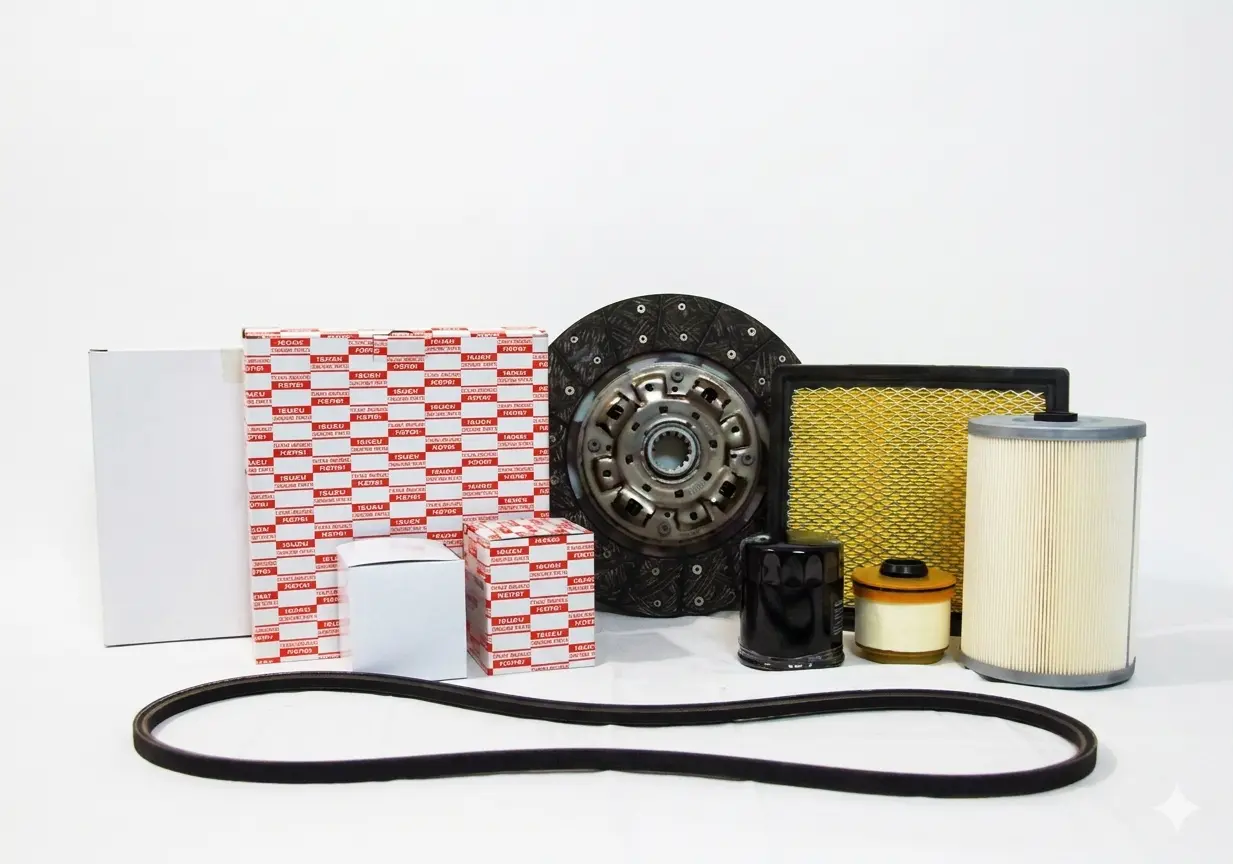
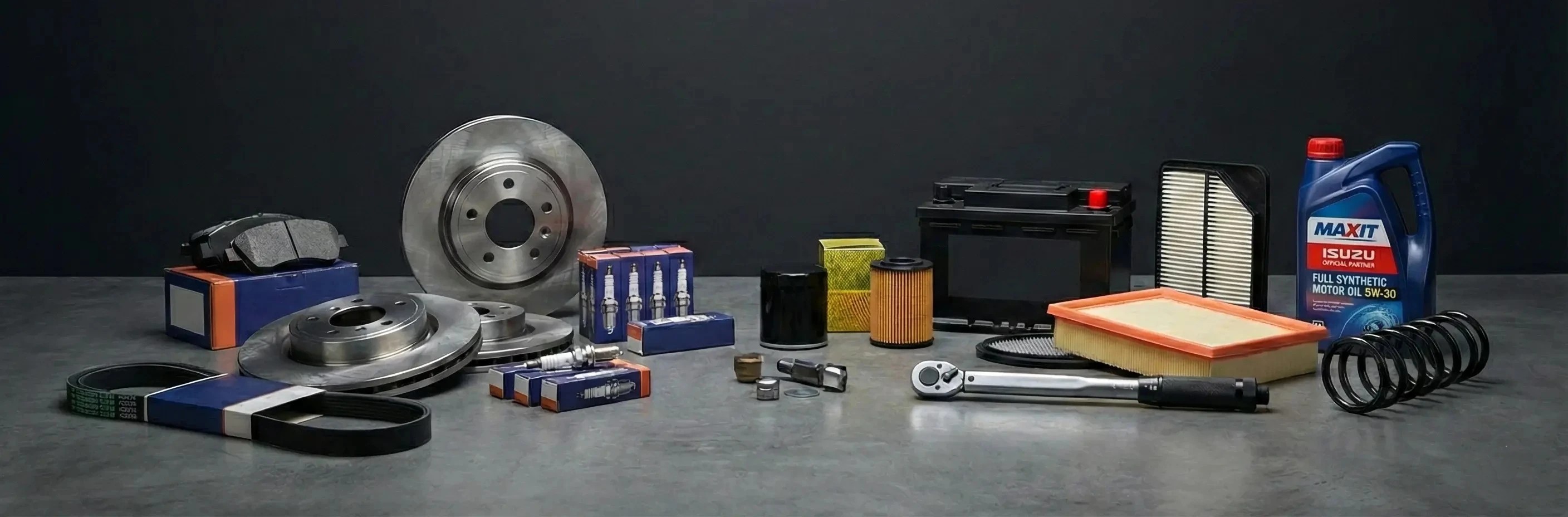
- Parts availability: Genuine Isuzu parts for both vehicles are available through the same dealer and workshop network across Kenya. Service costs are broadly comparable.
- Brand reputation: Both benefit from Isuzu's strong standing in the Kenyan commercial and NGO fleet market: parts supply, technician familiarity, and resale confidence are all built on the same foundation.
The Core Difference
The simplest summary: the D-Max is a pickup truck designed around a load tray. The mu-X is a seven-seat SUV designed around passenger comfort. They share a platform because that platform works exceptionally well for both purposes, but Isuzu made very different choices above it.
The D-Max prioritises payload capacity, towing strength, and off-road durability. Its rear suspension is a leaf-spring setup tuned for load-carrying. Its body is designed around the utility of an open tray.
The mu-X prioritises seating capacity, ride quality, and interior refinement. Its suspension is tuned for comfort over rough roads while carrying passengers. Its body is a closed SUV with three rows of seating and significantly better NVH (noise, vibration, harshness) management than the D-Max double cab.
Fuel Economy
In real-world Kenyan driving conditions (a mix of tarmac, murram, traffic, and loaded or unloaded use), both vehicles return similar fuel economy figures. Expect 10–13 litres per 100 km as a realistic range for the 4JJ1-powered variants of both.
The nuances worth knowing:
- Tarmac cruising: The mu-X has a slight advantage. Its more aerodynamic body profile reduces drag at highway speeds, and without a load tray creating turbulence, it can return 10–11 L/100 km on open road. The D-Max with an empty tray typically returns 11–12 L/100 km at highway speeds.
- Rough terrain: The D-Max is more efficient here. Its leaf-spring rear suspension and lower body height produce less body roll under load on rough tracks, and lower gearing in 4WD low reduces engine strain considerably. The mu-X uses engine power less efficiently when navigating demanding terrain due to its heavier body and higher centre of gravity.
- City driving: Broadly equal. Both suffer similarly in stop-start traffic. Fuel economy in Kenyan town driving typically drops to 13–16 L/100 km for either vehicle.
- Heavy load (D-Max specific): A D-Max carrying a full tray load or towing 2,000+ kg will see fuel economy drop to 14–18 L/100 km depending on terrain. This is the expected trade-off for working capacity and is not a weakness. It is physics.
Verdict: Broadly equal in typical use. Neither vehicle is dramatically more economical than the other in the conditions most Kenyan drivers encounter. mu-X has a marginal tarmac edge; D-Max has a marginal rough-terrain edge.
Cabin Comfort & Practicality
This is where the two vehicles diverge most significantly, and for buyers with families or regular passenger-carrying needs, it is the most important category in this comparison.
The mu-X Cabin
The mu-X cabin is designed with passengers as the primary consideration. It offers genuine three-row seating for up to seven adults, with the second-row seats providing comfortable legroom for adults on long journeys. The third row is best suited to children or shorter adults on medium-distance trips.
NVH management is substantially better than the D-Max double cab. Additional sound deadening, better door seal quality, and suspension tuning that prioritises passenger comfort over load-carrying translate to a noticeably quieter, more refined driving experience. On the Migori–Kisumu highway or the Nairobi–Mombasa route, the difference in passenger fatigue after three hours is real and material.
Interior features on mid-to-high spec mu-X models include a larger infotainment screen, rear air conditioning vents, captain's chairs option in some variants, and a higher-quality dashboard presentation overall.
The D-Max Double Cab Cabin
The D-Max double cab comfortably seats four adults, with the front two seats being excellent in terms of support and visibility. The rear seats are functional but clearly secondary: they are there, they work, and four adults will manage on a two-hour drive. On a six-hour journey, rear passengers will notice they are in a working vehicle.
Road noise is higher than the mu-X, particularly on coarse tarmac and murram roads. This is partly inherent to the pickup truck body style and partly a deliberate trade-off to keep the vehicle lighter and more capable off-road.
Verdict: mu-X wins clearly. It is a better passenger vehicle in every measurable way. If you regularly carry more than four people, or make long trips with family, the mu-X is the correct choice.
Payload & Towing Capacity
This is the D-Max's defining advantage. The open tray and purpose-built chassis make it a capable load carrier that the mu-X simply cannot replicate:
| Specification | Isuzu D-Max (Double Cab) | Isuzu mu-X |
|---|---|---|
| Payload capacity | Up to 1,090 kg in the tray | No load tray – N/A for commercial load |
| Towing capacity (braked) | Up to 3,500 kg | Up to 3,000 kg |
| Towing capacity (unbraked) | 750 kg | 750 kg |
| Load tray dimensions | ~1,520 mm L × 1,530 mm W × 475 mm H | N/A |
| GVM (Gross Vehicle Mass) | Up to 3,100 kg | Up to 2,900 kg |
The practical implication: if you carry farm produce, building materials, equipment, or livestock regularly, the D-Max is the only sensible choice. The mu-X cannot carry bulk loads and is not designed to.
On towing, both vehicles are genuinely capable. The D-Max at 3,500 kg can handle a loaded horse trailer, a mid-size caravan, or a heavy equipment trailer. The mu-X at 3,000 kg covers most leisure towing needs comfortably. The 500 kg difference is meaningful if you are regularly towing near capacity; for most leisure towing, the mu-X is perfectly adequate.
Verdict: D-Max wins decisively on payload. On towing, D-Max has a meaningful advantage for heavy work; the mu-X is competitive for lighter towing.
Off-Road Capability
Because they share a platform and 4WD system, both vehicles have genuine off-road capability that puts most "lifestyle SUVs" to shame. The distinction comes in the details:
- Ground clearance: The D-Max has marginally higher ground clearance, typically 230–240 mm versus the mu-X at approximately 215–225 mm depending on variant. In deep mud or over large rocks, this matters.
- Approach and departure angles: The D-Max has better departure angle due to the open tray, since there is no rear bumper extension hanging below the chassis line. On steep descents with obstacles, this is a real advantage.
- Water crossing: Both vehicles have similar wading depth. Be aware that the mu-X's enclosed body creates a slightly different risk profile in flood crossings: it is heavier and has more aerodynamic resistance to moving water. Apply the same rule to both: if you cannot see the road surface, do not enter.
- Suspension articulation: The D-Max leaf-spring rear is more tolerant of extreme articulation under load. The mu-X's rear suspension, while capable, is tuned for comfort and offers slightly less articulation under extreme off-road conditions.
- Recovery: In the event of a stuck vehicle, the D-Max's load tray provides anchor points for recovery straps and a solid connection point that the mu-X lacks on its rear.
Verdict: D-Max has the edge for serious off-road work. For murram roads, light bush tracks, and standard Kenyan upcountry driving, both vehicles are entirely capable. For demanding river crossings, deep mud, or expedition use, the D-Max is the stronger platform.
Long-Term Service Costs
Because both vehicles share most major mechanical components, annual service costs are broadly comparable. There are, however, a few nuances that affect the total cost of ownership:
Where Costs Are Equal
- Oil and filter changes: same engine, same intervals, same cost
- Timing belt service: same engine, same 80,000 km interval and cost range (Ksh 18,000–25,000)
- Gearbox and differential oil changes: same drivetrain components, same costs
- Genuine parts pricing: both draw from the same Isuzu parts catalogue
Where the mu-X Can Cost More
- Front suspension: The mu-X uses a more complex independent front suspension setup than the D-Max on some variants. When suspension components need replacement (control arms, ball joints, bushings), the mu-X parts can cost 20–40% more than equivalent D-Max components.
- Rear suspension: The mu-X's coil-spring or multi-link rear setup is more expensive to repair than the D-Max's leaf spring arrangement. D-Max leaf springs are among the cheapest and most universally serviceable suspension components available in Kenya.
- Body components: Replacement body panels, trim pieces, and glass for the mu-X SUV body are generally more expensive and less readily available than for the more common D-Max.
Where the D-Max Can Cost More
- Tray and load bed: If the load tray is damaged or corroded from commercial use, liner installation, tray replacement, or welding repairs add costs that mu-X owners never face.
- Running gear wear from loading: A D-Max used heavily for payload will wear leaf springs, shackle bushings, and rear tyres faster than a lightly-used vehicle. This is expected wear, not a fault.
Verdict: Broadly equal for standard use. The mu-X can be more expensive when suspension components need work. The D-Max is cheaper if suspension needs attention but more susceptible to wear from heavy use. Budget Ksh 25,000–45,000 per year for annual maintenance on either vehicle at 20,000–30,000 km per year.
Resale Value in Kenya
Resale value is deeply market-dependent in Kenya, and the D-Max and mu-X behave differently in different regions:
Western Kenya (Migori, Kisii, Kisumu, Homa Bay, Nyamira)
The D-Max has a strong and consistent resale market in this region. Its status as a working vehicle is universally understood: farmers, contractors, NGOs, and business owners all compete for well-maintained D-Max examples. A 2017 D-Max 4JJ1 with documented service history commands strong prices even at 150,000+ km.
The mu-X resale market in western Kenya is softer. The buyer pool is narrower, primarily families and professionals who are willing to pay a premium for comfort over utility. Prices are achievable, but the pool of buyers is smaller and negotiations tend to be more drawn out.
Nairobi and Urban Centres
Both vehicles resell strongly in urban markets. The mu-X is actively sought by urban families looking for a capable, comfortable three-row vehicle that handles both city streets and upcountry weekend trips. The D-Max maintains its commercial demand regardless of location.
Verdict: D-Max holds its value better in western Kenya. The mu-X is stronger in urban resale markets. If you are based in the Migori region and resale is a significant consideration, the D-Max is the lower-risk choice.
Head-to-Head Summary
| Category | mu-X | D-Max | Winner |
|---|---|---|---|
| Passenger capacity | 7 seats, 3 rows | 5 seats, 2 rows | mu-X |
| Cabin comfort / NVH | Significantly better insulation | Functional, louder at speed | mu-X |
| Fuel economy | Marginal tarmac advantage | Marginal rough-terrain advantage | Tie |
| Payload capacity | None (no load tray) | Up to 1,090 kg | D-Max |
| Towing capacity | Up to 3,000 kg | Up to 3,500 kg | D-Max |
| Off-road capability | Capable – handles most conditions | More capable, better angles & clearance | D-Max |
| Annual service costs | Suspension repairs can cost more | Suspension cheaper, wear from loading | Broadly equal |
| Resale (western Kenya) | Narrower buyer pool | Strong, broad demand | D-Max |
| Resale (urban Kenya) | Strong family SUV demand | Strong commercial demand | Equal |
The Verdict: Who Should Buy Which
After servicing both vehicles extensively, the decision almost always comes down to a simple question: is the primary job of this vehicle to carry people, or to carry things and work hard?
Choose the mu-X if you:
- Regularly carry 5–7 passengers
- Do daily school runs with children
- Take frequent long-distance family trips
- Want a quieter, more refined driving experience
- Occasionally go off-road but don't work the vehicle hard
- Are based primarily in an urban or semi-urban area
Choose the D-Max if you:
- Carry loads, equipment, or farm produce regularly
- Tow trailers, boats, or heavy equipment
- Work the vehicle hard in commercial or farming use
- Drive demanding off-road routes regularly
- Need the strongest resale in western Kenya
- Want the lowest repair costs for suspension components
Deciding between the mu-X and D-Max?
We service both vehicles every day. Come in and we can walk you through whichever model you are considering, inspect a specific vehicle before you buy, or discuss what to budget for ownership.