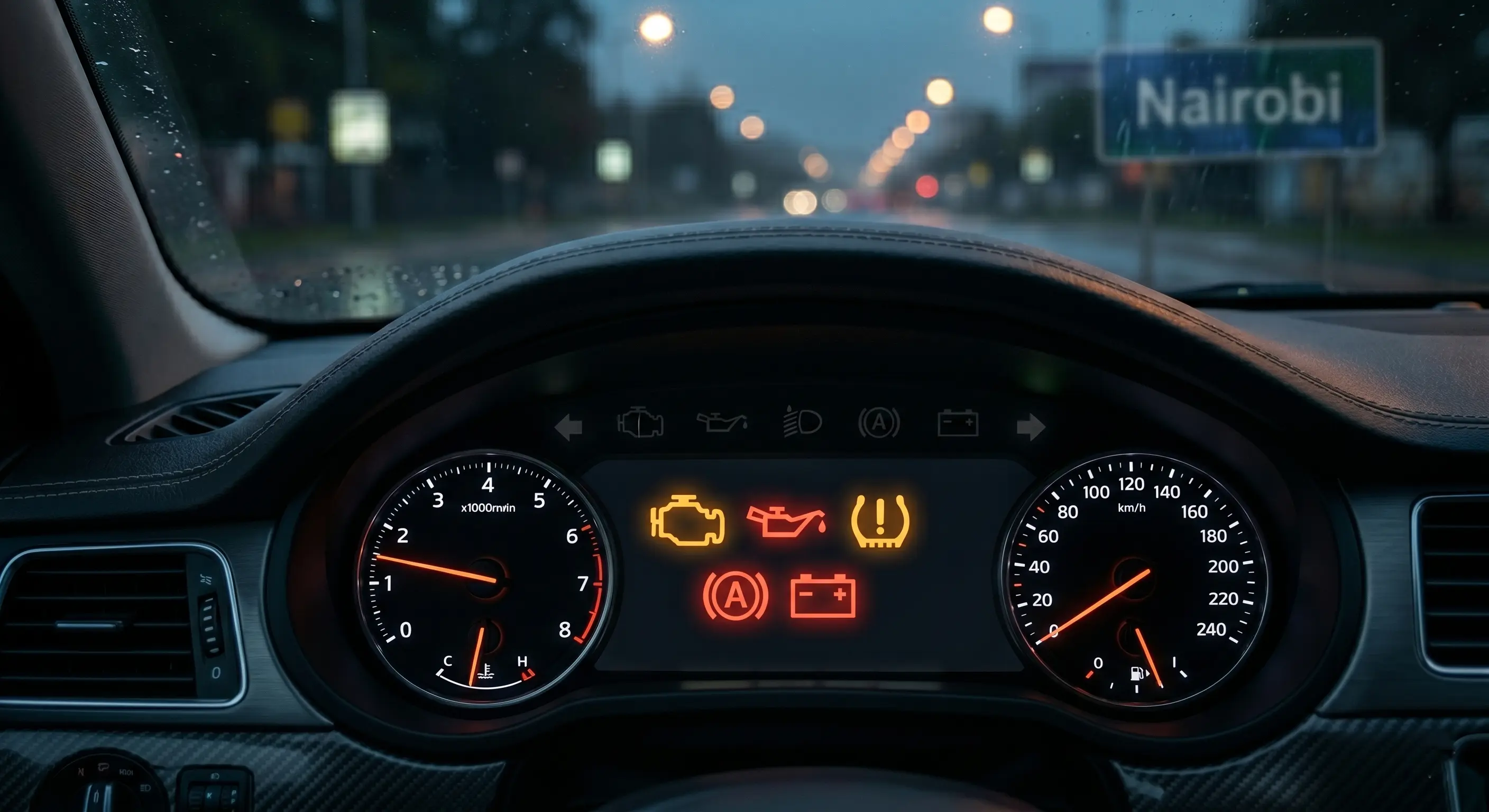
Overheating is among the most destructive and most preventable causes of major engine damage in Kenya. When a vehicle's cooling system cannot keep the engine within its operating temperature range, the consequences can be severe: a warped cylinder head, a blown head gasket, seized pistons, or in the worst case, a complete engine write-off. Every one of those outcomes begins with the temperature warning light coming on and the driver not stopping.
This guide covers every major cause of engine overheating in order of how commonly we see them in our workshop. For each cause, we explain what is happening, how to identify it, and what the repair involves. Work through them in order – the most likely cause is always at the top.
What to Do Right Now If Your Car Is Overheating
Pull over safely and switch off the engine. Do not open the radiator cap – the cooling system operates under pressure and scalding coolant can spray out violently, causing serious burns. Leave the bonnet closed for the first few minutes.
If you are in heavy traffic and cannot stop immediately: switch the air conditioning off and turn the cabin heater to maximum heat and maximum fan speed. This draws heat from the coolant through the heater core and buys you a small amount of time to reach a safe stopping point. Then stop.
Wait a minimum of 30 minutes before touching anything under the bonnet. Rushing the cooldown by pouring cold water on a hot engine can crack the cylinder head. Once cooled, check the coolant reservoir level and look underneath the vehicle for any puddles.
Do not restart and drive. Call +254 713 910 091 and we can advise whether the vehicle is safe to drive carefully or whether it needs to be towed.
Why Overheating Is More Common on Kenyan Roads
Kenya's driving conditions place the cooling system under significantly more stress than the European or Japanese conditions most vehicles were designed and calibrated for. Several factors combine to make overheating a routine workshop issue here rather than a rare one:
- High ambient temperatures – the temperature differential between the coolant and the surrounding air is smaller, reducing the radiator's ability to shed heat efficiently.
- Dusty murram roads – fine dust accumulates in the radiator fins over time, restricting the airflow that the radiator relies on to dissipate heat. Vehicles used on upcountry dirt roads are particularly vulnerable.
- Heavy loads and steep gradients – the western Kenya and upcountry terrain places sustained demand on the engine that flat-road driving does not. An engine working hard in low gear on a long climb generates significantly more heat than the same engine cruising on level tarmac.
- Stop-and-go Nairobi traffic – at low speed or stationary, the vehicle depends entirely on its cooling fan rather than ram air from forward motion. A marginal cooling system that manages on the open road can fail in heavy traffic.
- Deferred maintenance – coolant that has not been flushed in years becomes acidic and deposits rust and scale inside the cooling passages, reducing flow and efficiency progressively.
With this context in mind, here are the causes in order of probability.
Cause 1: Low or Leaking Coolant
Low or Leaking Coolant
Most common cause · Check this firstCoolant is the medium that carries heat from the engine to the radiator where it is dissipated. If the coolant level drops low enough, there is simply not enough fluid in the system to absorb and transport engine heat effectively. The engine temperature rises rapidly, particularly under load.
The cooling system is a closed loop and coolant should not disappear on its own. A consistently low level means there is a leak somewhere, even if you cannot see a puddle under the vehicle. Some leaks only occur under pressure when the engine is running and hot.
How to Identify It
- Coolant reservoir below the MIN mark when cold
- Coolant puddles under the vehicle – typically bright green, blue, or pink with a sweet smell
- White residue or staining around hose clamps, the radiator top and bottom tanks, or the water pump area
- Coolant level that drops despite regular top-ups
- Steam from under the bonnet in severe cases (coolant boiling off)
Common Leak Locations
- Radiator hoses – the upper and lower radiator hoses degrade with age, particularly at the clamp ends. Squeeze the hoses when cold; they should feel firm and flexible, not spongy, cracked, or oil-contaminated.
- Radiator itself – small cracks in the plastic end tanks or pinhole corrosion in the aluminium core. Look for dried white deposits around the radiator.
- Water pump – coolant weeping from the pump's drain hole or from the gasket face indicates a failing pump seal.
- Heater core – less visible since it is inside the dashboard; a sign is a sweet smell inside the cabin or a fogged windscreen when the heater is on.
- Cylinder head or head gasket – internal leak; no external puddle but the oil will appear milky and the exhaust may emit white smoke.
Hose replacement: Ksh 2,000–5,000. Radiator repair or replacement: Ksh 8,000–25,000 depending on vehicle and severity. All coolant leaks should be investigated rather than just topped up repeatedly.
Cause 2: Blocked or Dirty Radiator
Blocked or Dirty Radiator
Very common in Kenya · Often overlookedThe radiator works by passing hot coolant through a matrix of thin tubes surrounded by fins, with air flowing through the fins to carry the heat away. Any restriction to that airflow – dust, insects, grass seeds, plastic bags, or internal scale buildup – reduces the radiator's heat transfer efficiency and the engine runs hotter than it should.
External blockage is extremely common on Kenyan roads. Vehicles used on murram roads or in rural areas accumulate dust and debris in the radiator fins progressively and invisibly. A radiator that is 40–50% blocked externally can appear perfectly clean from the outside.
How to Identify It
- Overheating develops gradually over weeks or months rather than suddenly
- Vehicle runs hotter in traffic or at low speed than on the open road – the difference is airflow: at speed, ram air compensates for blocked fins; stationary, there is none
- Radiator fins visibly clogged with dust or debris when inspected closely
- Internal blockage: coolant flow through the radiator is restricted; upper hose gets very hot, lower hose stays relatively cool (little circulation through the core)
- Coolant in the reservoir appears rusty or darker than it should
Diagnosis Steps
- With the engine cold, inspect the front face of the radiator closely with a torch. Look for packed debris between the fins. Even if the fins appear clear, the layers further back may be blocked.
- With the engine at operating temperature, feel (carefully) the upper and lower radiator hoses. Both should be warm to hot. If the upper is very hot and the lower is significantly cooler, flow through the radiator core is restricted.
- For internal scale or corrosion blockage, a pressure flow test at a workshop will confirm reduced flow rate.
External clean (reverse-flush with water or compressed air): Ksh 1,500–3,500. Full radiator flush and chemical descale: Ksh 4,000–8,000. Radiator replacement if severely corroded internally: Ksh 12,000–28,000 depending on vehicle.
Cause 3: Failing Water Pump
Failing Water Pump
Common at higher mileage · Progressively worsensThe water pump circulates coolant continuously through the engine block, cylinder head, and radiator. A failing pump loses impeller efficiency gradually as internal corrosion erodes the impeller blades (particularly on pumps where the coolant was not changed regularly) or as the bearing begins to wear. The result is reduced coolant flow, which means the engine sheds heat more slowly and runs progressively hotter under load.
This is particularly relevant for D-Max and mu-X owners in Kenya where long distances and high loads are common. Water pump failure does not always announce itself dramatically; it can develop over thousands of kilometres as a gradual reduction in cooling capacity.
How to Identify It
- Temperature runs higher than normal under load but drops at higher speeds when ram air compensates
- Upper radiator hose very hot; lower hose noticeably cooler than it should be – indicating poor coolant circulation
- Coolant weeping from the small drain hole on the pump body (the weep hole) – indicates the mechanical seal has failed
- A rumbling, grinding, or whining sound from the front of the engine that changes with engine speed – bearing failure
- On belt-driven pumps: slight wobble or play in the pump pulley when the engine is off and cold
Diagnosis Steps
- With the engine cold, grip the water pump pulley and attempt to rock it side-to-side. Any movement indicates bearing wear.
- Look underneath the pump body for coolant staining around the weep hole (a small hole below the shaft). Dried coolant residue here confirms shaft seal failure.
- Run the engine to operating temperature and carefully compare the temperature of the upper and lower radiator hoses. A failing pump produces a significant temperature differential across the radiator.
- If you have access to an infrared thermometer: the inlet (top) and outlet (bottom) of the radiator should show a consistent temperature drop across the core of 15–25°C. A smaller drop indicates reduced flow.
Water pump replacement: Ksh 8,000–20,000 depending on vehicle and parts. D-Max and mu-X: typically the mid-range. Replace the thermostat and flush the cooling system at the same time.
Cause 4: Stuck or Failed Thermostat
Stuck or Failed Thermostat
Inexpensive fix · Easy to misdiagnoseThe thermostat is a temperature-sensitive valve that sits between the engine and the radiator. When the engine is cold, the thermostat remains closed, keeping coolant circulating only within the engine to help it reach operating temperature quickly. Once the coolant reaches the set temperature (typically 80–90°C), the thermostat opens and allows hot coolant to flow into the radiator to be cooled.
When the thermostat sticks closed, coolant cannot reach the radiator at all. The engine heats up rapidly without any cooling taking place. This produces very fast overheating – the temperature gauge climbs quickly rather than gradually.
A thermostat that sticks open does the opposite: the engine never fully warms up, fuel consumption increases, and the heater produces less warmth. This is less damaging but still warrants replacement.
How to Identify a Stuck-Closed Thermostat
- Temperature gauge climbs rapidly after the engine warms up, often reaching the red zone within minutes of starting a journey
- Lower radiator hose stays cold or barely warm even when the engine is hot – no coolant is flowing to the radiator
- Overheating occurs even with a full coolant reservoir
- Problem appears relatively suddenly rather than developing gradually over time
Diagnosis Steps
- Start the engine from cold. Leave the lower radiator hose accessible and feel it periodically (carefully). It should begin to warm up noticeably within 5–8 minutes of the engine running, as the thermostat opens. If it remains cold after 10 minutes while the temperature gauge is rising, the thermostat is stuck closed.
- An alternative test: remove the thermostat and place it in a pot of water. Heat the water on a stove (or carefully over a flame) and watch whether the valve opens as the water approaches 80–90°C. A stuck thermostat will not open. A good thermostat opens visibly.
Thermostat replacement is one of the least expensive cooling system repairs: Ksh 2,500–6,000 in parts and labour for most Kenyan vehicles including the D-Max and mu-X. Never reinstall an old thermostat if the system is being opened – always replace with a new one.
Cause 5: Faulty Cooling Fan or Fan Clutch
Faulty Cooling Fan or Fan Clutch
Classic traffic-only overheating symptomThe cooling fan draws air through the radiator when the vehicle is stationary or moving slowly. At higher road speeds, forward motion provides sufficient airflow on its own. This means a faulty fan produces a very specific overheating pattern: the vehicle overheats in slow traffic or when idling but cools down once you pick up speed on the open road.
Vehicles use one of two fan types. Electric fans (controlled by a thermoswitch or ECU) fail either because the motor burns out or because the control relay or thermoswitch fails. Belt-driven fans use a viscous fan clutch that engages progressively with temperature; a worn clutch fails to engage properly and the fan spins freely without drawing meaningful airflow.
How to Identify It
- Overheating occurs primarily in traffic, at idle, or during slow driving – but the temperature normalises at higher road speeds
- For electric fans: the fan is not audibly running when the engine reaches operating temperature (it should be clearly audible when stationary and hot)
- For viscous fan clutch: with the engine cold and off, the fan should resist being spun by hand. If it spins very freely with little resistance, the clutch has failed
- Air conditioning use worsens the overheating noticeably – the AC condenser in front of the radiator adds heat load that a faulty fan cannot compensate for
Diagnosis Steps
- Allow the engine to reach full operating temperature in a stationary position. Observe whether the cooling fan is running (electric) or spinning audibly (belt-driven). An electric fan that is not running when the engine is hot indicates a failed motor, relay, or thermoswitch.
- With the engine completely cold and switched off, attempt to spin the fan blade by hand. Belt-driven viscous fans should have noticeable resistance. A fan that spins easily with no resistance has a worn clutch.
- For electric fans, a workshop can test the relay and thermoswitch with a multimeter in under ten minutes.
Electric fan motor: Ksh 6,000–15,000. Relay or thermoswitch replacement: Ksh 1,500–4,000. Viscous fan clutch: Ksh 8,000–18,000 depending on vehicle. This is a straightforward workshop repair once correctly diagnosed.
Cause 6: Head Gasket Failure
Head Gasket Failure
Most serious · Often the result of ignored overheatingThe head gasket seals the joint between the engine block and the cylinder head, keeping combustion gases, oil, and coolant in their separate passages. A failing head gasket allows one or more of these to mix. In the most common failure pattern for overheating vehicles in Kenya, hot combustion gases enter the coolant passages, pressurising the cooling system and causing it to push coolant out of the reservoir – which then causes overheating through loss of coolant.
Head gasket failure is almost always a consequence rather than a standalone cause. It typically results from a previous overheating event that warped or stressed the cylinder head. This is why stopping at the first sign of overheating is so critical – it prevents a manageable repair from becoming this one.
How to Identify It
- White smoke from the exhaust on cold starts, with a sweet smell – coolant burning in the combustion chamber
- Oil on the dipstick appears milky, creamy, or light brown – coolant contaminating the engine oil
- Coolant level drops repeatedly despite no visible external leaks
- Bubbling in the coolant reservoir when the engine is running – combustion gases entering the cooling system
- Overheating that does not respond to the usual fixes (new thermostat, coolant flush) – the system is being pressurised by combustion gases
- In severe cases: coolant in the combustion chamber produces a hydraulic lock and the engine will not turn over
Diagnosis Steps
- Check the dipstick for milky or frothy oil. This is the fastest visual indicator of coolant contamination in the engine oil.
- With the engine at operating temperature, remove the coolant reservoir cap (carefully, with a rag) and observe whether bubbles are rising into the reservoir. Combustion gas bubbling is a strong indicator of head gasket failure.
- A combustion leak test (also called a block test) uses a chemical kit that changes colour in the presence of combustion gases in the coolant. This is the definitive workshop test and takes about ten minutes.
- Compression testing across all cylinders will reveal whether any cylinder is losing compression into the coolant passages.
Head gasket replacement: Ksh 35,000–80,000+ depending on vehicle. If the cylinder head is warped and requires resurfacing (skimming), add Ksh 8,000–15,000 to the above. This is the bill that results from ignoring an earlier, cheaper overheating fix.
Quick Diagnosis Flowchart
Work through these questions in order to narrow down the most likely cause before calling a workshop.
The Cost of Ignoring Overheating
Every overheating cause has a repair cost. The pattern we see consistently in our workshop is that the repair cost at the point of the warning light is a small fraction of the cost of the failure that follows if it is ignored.
Act at the Warning vs. Drive Through It – The Cost Gap
Stopping when the temperature warning light comes on is the single most valuable thing you can do to protect your engine. The vehicle is telling you what it needs. The question is whether you act on the first message, or wait for the expensive one.
Overheating problem, or not sure what is causing it?
Call us first. We can walk you through what to check on the phone, and if it needs a hands-on diagnosis, we will book you in the same day. Early diagnosis is always cheaper than the alternative.